 Menu
Note. Scroll up to view more topics.
Menu
Note. Scroll up to view more topics.
 Home
Home
 Contact Us
 STUDY SKILLS
 Skills of effective study
Making study-notes
Group Discussion
How to concentrate
Developing interest in study
Making preparation for exam
Test Taking Strategies
How to relieve Exam stress?
Time Management for studies
Attempting Computer-based Exam
How to sharpen your brain?
Causes of failure in Exam
Exam-format-wise Preparation
Parents’ Role in Child’s Education
How to improve memory power?
ENGLISH BASICS Noun and its Types
Countable and Uncountable Nouns
Clause
Types of Clauses
Phrase
Types of Phrases
Phrase & Clause - Difference
Verb - Formation & forms of Verbs
Main Verb and Auxiliary Verb
Transitive and Intransitive Verb
Adjective
Comparative and Superlative
Adverb - Use & Formation
Types of Adverb
Pronoun
Types of Pronoun
Prepositional Verb
Coordinating & Subordinating Conjunctions
English Tenses
Active & Passive Voice
Direct & Indirect Narration
TEST PREPARATION IELTS Exam Preparation Guide
CSS Exam, Pakistan
NTS Test (NAT-I, II & GAT)
GRE General Test
MCAT - Medical College Aptitude Test
Entertainment - Funny Jokes Related Topics
Skills of effective study
Making study-notes
Group Discussion
How to concentrate
Developing interest in study
Making preparation for exam
Test Taking Strategies
How to relieve Exam stress?
Time Management for studies
Attempting Computer-based Exam
How to sharpen your brain?
Causes of failure in Exam
Exam-format-wise Preparation
Parents’ Role in Child’s Education
How to improve memory power?
ENGLISH BASICS Noun and its Types
Countable and Uncountable Nouns
Clause
Types of Clauses
Phrase
Types of Phrases
Phrase & Clause - Difference
Verb - Formation & forms of Verbs
Main Verb and Auxiliary Verb
Transitive and Intransitive Verb
Adjective
Comparative and Superlative
Adverb - Use & Formation
Types of Adverb
Pronoun
Types of Pronoun
Prepositional Verb
Coordinating & Subordinating Conjunctions
English Tenses
Active & Passive Voice
Direct & Indirect Narration
TEST PREPARATION IELTS Exam Preparation Guide
CSS Exam, Pakistan
NTS Test (NAT-I, II & GAT)
GRE General Test
MCAT - Medical College Aptitude Test
Entertainment - Funny Jokes Related Topics
- Home
- Study Skills
 Skills of effective study Making study-notes Perseverance in study How to concentrate Developing interest in study Group Discussion - Importance Where to study? When to study? Start your study now Making preparation for exam
Preparation according to exam-format
Test Taking Strategies
How to relieve Exam stress?
How to take Computer-based Exam
Making study-notes for exam? Why do students get less marks?
Skills of effective study Making study-notes Perseverance in study How to concentrate Developing interest in study Group Discussion - Importance Where to study? When to study? Start your study now Making preparation for exam
Preparation according to exam-format
Test Taking Strategies
How to relieve Exam stress?
How to take Computer-based Exam
Making study-notes for exam? Why do students get less marks?
- English Basics
Articles
Sentence
Subject, Predicate & Object
Kinds of Sentence (Function-wise)
Kinds of Sentence (Structure-wise)
Phrase & Clause – Comparison
Phrase
Clause
High Frequency words - English
English Tense – Meaning
Present Simple Tense
Present Continuous Tense
Present Perfect Tense
Present Perfect Continuous Tense
Past Simple Tense
Past Continuous Tense
Past Perfect Tense
Past Perfect Continuous Tense
Future Simple Tense
Future Continuous Tense
Future Perfect Tense
Future Perfect Continuous Tense
Active & Passive Voice – Meaning
Passive Voice for Tenses
Passive Voice for Modals
Rules for Imperative Sentences
Sentences which can’t be changed
Direct & Indirect Narration – Meaning
Indirect Speech for Tenses
Rules for Interrogative Sentences
Indirect Speech for Modals
Rules for Exclamatory & Imperatives
Rules for change in Pronoun & Time
- Test Preparation
- Resources
- Contact Us
- Entertainment
- Jobs
- News
Types of Attitude Change
An attitude is a positive or negative evaluation of an object. It is expressed in an individual’s liking or disliking and favoring or disfavoring something. For instance, some students hold a positive attitude toward the use of the internet because they believe it provides valuable study resources. In contrast, others may have a negative attitude toward it, perceiving it as a source of distraction that consumes time in non-academic activities.
Attitude change can be defined as the process of alteration or modification in an individual’s existing attitude toward an object.
Attitudes are not fixed; they can change over time as individuals encounter new experiences and information. These experiences may reshape or modify existing attitudes. For example, a student who initially holds a negative attitude toward the use of the internet may develop a positive attitude after recognizing its academic benefits.
There are two main types of attitude change:
- Incongruent Attitude Change
- Congruent Attitude Change

Incongruent Attitude Change
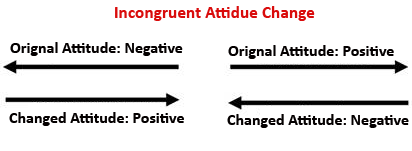
Incongruent attitude change refers to a type of attitude change in which an individual’s attitude shifts in the opposite direction of the original position. In this case, a positive attitude may become negative, or a negative attitude may become positive.
For example, a vegetarian individual may hold a negative attitude toward meat consumption and avoid it. However, upon learning that meat is a significant source of essential protein for health, the individual may develop a positive attitude toward its consumption and begin to include it in their diet. This represents a shift from a negative to a positive attitude, illustrating incongruent attitude change.
Another example involves a smoker who initially holds a positive attitude toward smoking due to personal enjoyment. If the individual later becomes aware of the serious health risks associated with smoking, this awareness may lead to the development of a negative attitude and an attempt to quit. This reversal in attitude direction is characteristic of incongruent attitude change.
Similarly, some individuals may have a positive attitude toward staying awake throughout the night. However, upon recognizing the adverse health effects associated with sleep deprivation, they may develop a negative attitude toward this behavior. This change, once again, reflects a shift in the opposite direction of the original attitude.

Congruent Attitude Change
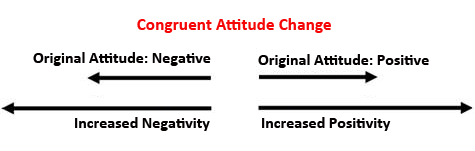
Congruent attitude change refers to a type of attitude change in which an individual’s existing attitude is reinforced in the same direction. In this case, a positive attitude becomes stronger, and a negative attitude becomes more intense.
For example, an individual may hold a positive attitude toward gym exercises because they believe such activities help in developing a muscular physique. If the individual later recognizes that gym exercises also contribute to overall health, including cardiovascular and mental well-being, their favorable attitude is further strengthened, leading them to invest more time in such activities. This illustrates a positive attitude becoming more positive, which is characteristic of congruent attitude change.
Similarly, individuals often hold a negative attitude toward extravagance, defined as unnecessary or excessive spending. If they experience an economic crisis in which their financial needs exceed their savings, this situation may intensify their negative attitude toward wasteful expenditure. As a result, they may adopt more prudent financial habits, such as increased saving. This demonstrates how a negative attitude can become more negative, reflecting congruent attitude change.
 Why People Change Their Attitudes (Factors Influencing Attitude Change)
Attitudes are not fixed; they evolve over time due to various psychological, social, and environmental influences. Understanding why people change their attitudes is essential for explaining human behavior in areas such as education, health, and social interaction. The major factors contributing to attitude change are discussed below:
1. New Information and Knowledge
One of the most significant reasons for attitude change is exposure to new information. When individuals acquire knowledge that challenges their existing beliefs, they may revise their attitudes accordingly.
For example, learning about the health risks of smoking may lead a person to develop a negative attitude toward it.
2. Personal Experience
Direct personal experiences strongly influence attitudes. Positive or negative experiences with an object, person, or situation can reshape existing attitudes.
For instance, a person who has a positive experience with online learning may develop a more favorable attitude toward digital education.
3. Social Influence and Peer Pressure
Attitudes are often shaped and reshaped through interaction with others. Family, friends, teachers, and society can influence an individual’s attitudes through discussion, persuasion, or pressure to conform.
People may change their attitudes to align with group norms or to gain social acceptance.
4. Persuasion and Communication
Attitudes can change through persuasive communication, such as advertisements, speeches, or media messages. The credibility of the source, the strength of the message, and the emotional appeal all play important roles in influencing attitude change.
5. Cognitive Dissonance
When individuals experience inconsistency between their attitudes and behavior, they feel psychological discomfort (known as cognitive dissonance). To reduce this discomfort, they may change their attitudes to match their actions.
For example, a person who values health but smokes may change their attitude toward smoking to reduce inner conflict.
6. Emotional Factors
Emotions such as fear, happiness, or empathy can significantly influence attitudes. Emotional experiences or appeals (e.g., fear-based health campaigns) can lead to rapid attitude change.
7. Cultural and Social Environment
Cultural values, traditions, and societal norms play a key role in shaping attitudes. As individuals are exposed to different cultures or changing social environments, their attitudes may also change over time.
8. Education and Awareness
Education promotes critical thinking and awareness, which can lead to attitude change. As individuals become more informed and aware of issues, they are more likely to reassess and modify their attitudes.
Conclusion
In summary, attitude change occurs due to a combination of internal and external factors, including knowledge, experience, social interaction, and emotional influences. These factors highlight that attitudes are dynamic and continuously shaped by the individual’s environment and experiences.


Copyright © 2023. STUDYANDEXAM. All Rights Reserved.