 Menu
Note. Scroll up to view more topics.
Menu
Note. Scroll up to view more topics.
 Home
Home
 Contact Us
 STUDY SKILLS
 Skills of effective study
Making study-notes
Group Discussion
How to concentrate
Developing interest in study
Making preparation for exam
Test Taking Strategies
How to relieve Exam stress?
Time Management for studies
Attempting Computer-based Exam
How to sharpen your brain?
Causes of failure in Exam
Exam-format-wise Preparation
Parents’ Role in Child’s Education
How to improve memory power?
ENGLISH BASICS Noun and its Types
Countable and Uncountable Nouns
Clause
Types of Clauses
Phrase
Types of Phrases
Phrase & Clause - Difference
Verb - Formation & forms of Verbs
Main Verb and Auxiliary Verb
Transitive and Intransitive Verb
Adjective
Comparative and Superlative
Adverb - Use & Formation
Types of Adverb
Pronoun
Types of Pronoun
Prepositional Verb
Coordinating & Subordinating Conjunctions
English Tenses
Active & Passive Voice
Direct & Indirect Narration
TEST PREPARATION IELTS Exam Preparation Guide
CSS Exam, Pakistan
NTS Test (NAT-I, II & GAT)
GRE General Test
MCAT - Medical College Aptitude Test
Entertainment - Funny Jokes Related Topics
Vitamin B2 – Role & Deficiency
Vitamin B6 – Occurrence, Deficiency
Nicotinamide –Occurrence, Deficiency
Biotin – Occurrence, Role, Deficiency
Folic Acid (FA) or Pteroyglutamic Acid
Vitamin B12 – Occurrence, Role
Symptoms of Vitamin B12 Deficiency
Thiamine – Properties & Role
Effects of Thiamine Deficiency
Vitamin C – Changes to it in body
Vitamin A – Occurrence & Absorption
Skills of effective study
Making study-notes
Group Discussion
How to concentrate
Developing interest in study
Making preparation for exam
Test Taking Strategies
How to relieve Exam stress?
Time Management for studies
Attempting Computer-based Exam
How to sharpen your brain?
Causes of failure in Exam
Exam-format-wise Preparation
Parents’ Role in Child’s Education
How to improve memory power?
ENGLISH BASICS Noun and its Types
Countable and Uncountable Nouns
Clause
Types of Clauses
Phrase
Types of Phrases
Phrase & Clause - Difference
Verb - Formation & forms of Verbs
Main Verb and Auxiliary Verb
Transitive and Intransitive Verb
Adjective
Comparative and Superlative
Adverb - Use & Formation
Types of Adverb
Pronoun
Types of Pronoun
Prepositional Verb
Coordinating & Subordinating Conjunctions
English Tenses
Active & Passive Voice
Direct & Indirect Narration
TEST PREPARATION IELTS Exam Preparation Guide
CSS Exam, Pakistan
NTS Test (NAT-I, II & GAT)
GRE General Test
MCAT - Medical College Aptitude Test
Entertainment - Funny Jokes Related Topics
Vitamin B2 – Role & Deficiency
Vitamin B6 – Occurrence, Deficiency
Nicotinamide –Occurrence, Deficiency
Biotin – Occurrence, Role, Deficiency
Folic Acid (FA) or Pteroyglutamic Acid
Vitamin B12 – Occurrence, Role
Symptoms of Vitamin B12 Deficiency
Thiamine – Properties & Role
Effects of Thiamine Deficiency
Vitamin C – Changes to it in body
Vitamin A – Occurrence & Absorption
- Home
- Study Skills
 Skills of effective study Making study-notes Perseverance in study How to concentrate Developing interest in study Group Discussion - Importance Where to study? When to study? Start your study now Making preparation for exam
Preparation according to exam-format
Test Taking Strategies
How to relieve Exam stress?
How to take Computer-based Exam
Making study-notes for exam? Why do students get less marks?
Skills of effective study Making study-notes Perseverance in study How to concentrate Developing interest in study Group Discussion - Importance Where to study? When to study? Start your study now Making preparation for exam
Preparation according to exam-format
Test Taking Strategies
How to relieve Exam stress?
How to take Computer-based Exam
Making study-notes for exam? Why do students get less marks?
- English Basics
Articles
Sentence
Subject, Predicate & Object
Kinds of Sentence (Function-wise)
Kinds of Sentence (Structure-wise)
Phrase & Clause – Comparison
Phrase
Clause
High Frequency words - English
English Tense – Meaning
Present Simple Tense
Present Continuous Tense
Present Perfect Tense
Present Perfect Continuous Tense
Past Simple Tense
Past Continuous Tense
Past Perfect Tense
Past Perfect Continuous Tense
Future Simple Tense
Future Continuous Tense
Future Perfect Tense
Future Perfect Continuous Tense
Active & Passive Voice – Meaning
Passive Voice for Tenses
Passive Voice for Modals
Rules for Imperative Sentences
Sentences which can’t be changed
Direct & Indirect Narration – Meaning
Indirect Speech for Tenses
Rules for Interrogative Sentences
Indirect Speech for Modals
Rules for Exclamatory & Imperatives
Rules for change in Pronoun & Time
- Test Preparation
- Resources
- Contact Us
- Entertainment
- Jobs
- News
Vitamin B5 (Pantothenic Acid)
Pantothenic acid, commonly known as Vitamin B5, is a biologically important compound belonging to the group of water-soluble B-complex vitamins. It is essential for all living cells, reflecting its universal role in metabolism.
Chemically, it is described as a viscous, pale yellow to yellowish oily substance. It shows a characteristic stability pattern: it is relatively stable to moist heat, but destroyed by dry heat, which is important in food processing and storage.
Commercially, pantothenic acid is commonly available in the form of its sodium and calcium salts, which are more stable and easier to handle in pharmaceutical preparations.
Its chemical formula is given below: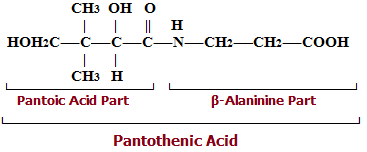
Pantothenic acid functions as a fundamental building block in metabolism due to its incorporation into coenzyme systems that regulate energy production and biosynthesis.
 Occurrence of Vitamin B5 (Pantothenic Acid)
It is very widespread and occurs specially in liver kidney, eggs, milk, peas, cauliflower, cabbage, potatoes and tomatoes. The intestinal E –coli also synthesize it and some may be absorbed. It is due to its widespread occurrence that it was named Pantothenic acid (pantos=every where). However, this vitamin is quite unstable.
Biochemical Role of Vitamin B5 (Pantothenic Acid)
Pantothenic acid plays a central biochemical role primarily through its incorporation into coenzyme A (CoA-SH). This coenzyme is indispensable for the metabolism of carbohydrates, proteins, and fats, acting as a universal carrier of acyl groups in metabolic reactions.
Within the body, coenzyme A participates in numerous essential physiological and biochemical processes, including:
- formation of acetyl-S-CoA
- formation of succinyl-S-CoA
- oxidation of fatty acids
- utilization of acetoacetic acid
- synthesis of cholesterol
- multiple other biochemical pathways
(Coenzyme A can be represented as given below in structural form in standard texts.)
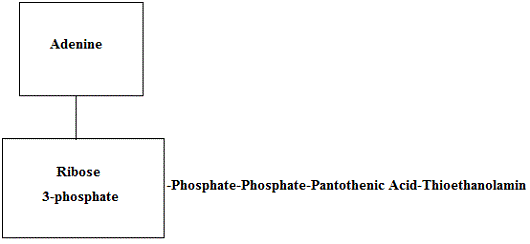
In addition to coenzyme A, pantothenic acid is also a component of the acyl carrier protein (ACP). ACP plays a crucial role in the biosynthesis of fatty acids, acting as a carrier for growing fatty acid chains during enzymatic assembly.
It is also noted that folic acid and biotin are thought to be required for the proper utilization of pantothenic acid, suggesting interdependence among B-complex vitamins in metabolic networks.
At the biochemical level, pantothenic acid participates in the biosynthesis pathway of coenzyme A, where it is first converted into 4′-phosphopantetheine. This intermediate acts as an essential prosthetic group for both ACP and fatty acid synthase complexes.
Major Coenzyme A-Dependent Pathways
Pantothenic acid, through CoA, is involved in a wide range of acyl transfer reactions, which are central to metabolism. These include:
- Citric acid cycle, via acetyl-CoA and succinyl-CoA
- Fatty acid metabolism, including both β-oxidation and fatty acid synthesis
- Amino acid metabolism
- Ketone body metabolism
- Steroid and cholesterol biosynthesis
Additionally, pantothenic acid undergoes phosphorylation by the enzyme pantothenate kinase, which represents the rate-limiting step in coenzyme A synthesis. This step is therefore crucial in regulating overall CoA availability in cells.
Symptoms of Deficiency of Pantothenic Acid
Experimental deficiency studies, particularly in rats, have demonstrated a range of physiological and developmental disturbances.
In experimental animal models, the following effects have been observed:
- Reproductive function is seriously affected in both male and female rats.
- Graying of hair (achromotrichia) occurs in black rats. However, this is not specific to pantothenic acid deficiency and may also appear in deficiencies of other factors, such as inositol. Interestingly, graying of hair is prevented by adrenalectomy in pantothenic acid-deficient rats.
- The cholesterol content of the adrenal cortex is decreased, since coenzyme A required for cholesterol synthesis becomes insufficient. This leads to adrenal cortical atrophy.
- Presence of porphyrin-stained or bloody whiskers and circumocular hair loss (spectacle eyes).
- Reduced ability to develop conditioned reflexes.
- Gastrointestinal disturbances, including duodenal ulcers.
In addition, pantothenic acid deficiency in animals leads to a general impairment of energy metabolism, since reduced availability of acetyl-CoA disrupts multiple interconnected metabolic pathways simultaneously.
Effects of Deficiency of Vitamin B5 in Human Beings
In humans, pantothenic acid deficiency is extremely rare under normal dietary conditions due to its widespread occurrence in foods. However, when deficiency does occur—typically in cases of severe malnutrition or experimental deprivation—it produces a range of clinical symptoms.
Observed effects include:
- Irritability, restlessness, disturbed sleep rhythm, and excessive fatigue on mild exercise
- Gastrointestinal disturbances
- Reduced responsiveness of the adrenal cortex to ACTH. For example, the normal eosinopenic response to ACTH administration does not occur
- Burning feet syndrome
- Increased incidence of respiratory infections and upper abdominal pain
In more recent clinical observations, pantothenic acid deficiency has also been associated with:
- Paresthesia (numbness and tingling sensations)
- Sleep disturbances
- Fatigue and irritability in severe deficiency states
Overall, pantothenic acid deficiency in humans remains rare because of its ubiquitous presence in food sources.
Daily Requirement of Pantothenic Acid
The exact daily requirement of pantothenic acid has not been definitively established. However, based on available nutritional studies, an intake of approximately:
- 10 to 15 mg/day is considered sufficient for adults.
Modern nutritional guidelines therefore often use the concept of Adequate Intake (AI) rather than a strict Recommended Dietary Allowance (RDA). This approach is used because clear deficiency states are uncommon in normal populations, making precise requirement estimation difficult.


Copyright © 2023. STUDYANDEXAM. All Rights Reserved.