 Menu
Note. Scroll up to view more topics.
Menu
Note. Scroll up to view more topics.
 Home
Home
 Contact Us
 STUDY SKILLS
 Skills of effective study
Making study-notes
Group Discussion
How to concentrate
Developing interest in study
Making preparation for exam
Test Taking Strategies
How to relieve Exam stress?
Time Management for studies
Attempting Computer-based Exam
How to sharpen your brain?
Causes of failure in Exam
Exam-format-wise Preparation
Parents’ Role in Child’s Education
How to improve memory power?
ENGLISH BASICS Noun and its Types
Countable and Uncountable Nouns
Clause
Types of Clauses
Phrase
Types of Phrases
Phrase & Clause - Difference
Verb - Formation & forms of Verbs
Main Verb and Auxiliary Verb
Transitive and Intransitive Verb
Adjective
Comparative and Superlative
Adverb - Use & Formation
Types of Adverb
Pronoun
Types of Pronoun
Prepositional Verb
Coordinating & Subordinating Conjunctions
English Tenses
Active & Passive Voice
Direct & Indirect Narration
TEST PREPARATION IELTS Exam Preparation Guide
CSS Exam, Pakistan
NTS Test (NAT-I, II & GAT)
GRE General Test
MCAT - Medical College Aptitude Test
Entertainment - Funny Jokes Related Topics
Vitamin B6 – Occurrence, Deficiency
Vitamin B5 – Role & Deficiency
Nicotinamide –Occurrence, Deficiency
Biotin – Occurrence, Role, Deficiency
Folic Acid (FA) or Pteroyglutamic Acid
Vitamin B12 – Occurrence, Role
Symptoms of Vitamin B12 Deficiency
Thiamine – Properties & Role
Effects of Thiamine Deficiency
Vitamin C – Changes to it in body
Vitamin A – Occurrence & Absorption
Skills of effective study
Making study-notes
Group Discussion
How to concentrate
Developing interest in study
Making preparation for exam
Test Taking Strategies
How to relieve Exam stress?
Time Management for studies
Attempting Computer-based Exam
How to sharpen your brain?
Causes of failure in Exam
Exam-format-wise Preparation
Parents’ Role in Child’s Education
How to improve memory power?
ENGLISH BASICS Noun and its Types
Countable and Uncountable Nouns
Clause
Types of Clauses
Phrase
Types of Phrases
Phrase & Clause - Difference
Verb - Formation & forms of Verbs
Main Verb and Auxiliary Verb
Transitive and Intransitive Verb
Adjective
Comparative and Superlative
Adverb - Use & Formation
Types of Adverb
Pronoun
Types of Pronoun
Prepositional Verb
Coordinating & Subordinating Conjunctions
English Tenses
Active & Passive Voice
Direct & Indirect Narration
TEST PREPARATION IELTS Exam Preparation Guide
CSS Exam, Pakistan
NTS Test (NAT-I, II & GAT)
GRE General Test
MCAT - Medical College Aptitude Test
Entertainment - Funny Jokes Related Topics
Vitamin B6 – Occurrence, Deficiency
Vitamin B5 – Role & Deficiency
Nicotinamide –Occurrence, Deficiency
Biotin – Occurrence, Role, Deficiency
Folic Acid (FA) or Pteroyglutamic Acid
Vitamin B12 – Occurrence, Role
Symptoms of Vitamin B12 Deficiency
Thiamine – Properties & Role
Effects of Thiamine Deficiency
Vitamin C – Changes to it in body
Vitamin A – Occurrence & Absorption
- Home
- Study Skills
 Skills of effective study Making study-notes Perseverance in study How to concentrate Developing interest in study Group Discussion - Importance Where to study? When to study? Start your study now Making preparation for exam
Preparation according to exam-format
Test Taking Strategies
How to relieve Exam stress?
How to take Computer-based Exam
Making study-notes for exam? Why do students get less marks?
Skills of effective study Making study-notes Perseverance in study How to concentrate Developing interest in study Group Discussion - Importance Where to study? When to study? Start your study now Making preparation for exam
Preparation according to exam-format
Test Taking Strategies
How to relieve Exam stress?
How to take Computer-based Exam
Making study-notes for exam? Why do students get less marks?
- English Basics
Articles
Sentence
Subject, Predicate & Object
Kinds of Sentence (Function-wise)
Kinds of Sentence (Structure-wise)
Phrase & Clause – Comparison
Phrase
Clause
High Frequency words - English
English Tense – Meaning
Present Simple Tense
Present Continuous Tense
Present Perfect Tense
Present Perfect Continuous Tense
Past Simple Tense
Past Continuous Tense
Past Perfect Tense
Past Perfect Continuous Tense
Future Simple Tense
Future Continuous Tense
Future Perfect Tense
Future Perfect Continuous Tense
Active & Passive Voice – Meaning
Passive Voice for Tenses
Passive Voice for Modals
Rules for Imperative Sentences
Sentences which can’t be changed
Direct & Indirect Narration – Meaning
Indirect Speech for Tenses
Rules for Interrogative Sentences
Indirect Speech for Modals
Rules for Exclamatory & Imperatives
Rules for change in Pronoun & Time
- Test Preparation
- Resources
- Contact Us
- Entertainment
- Jobs
- News
Vitamin B2 (Riboflavin)
Chemical Structure
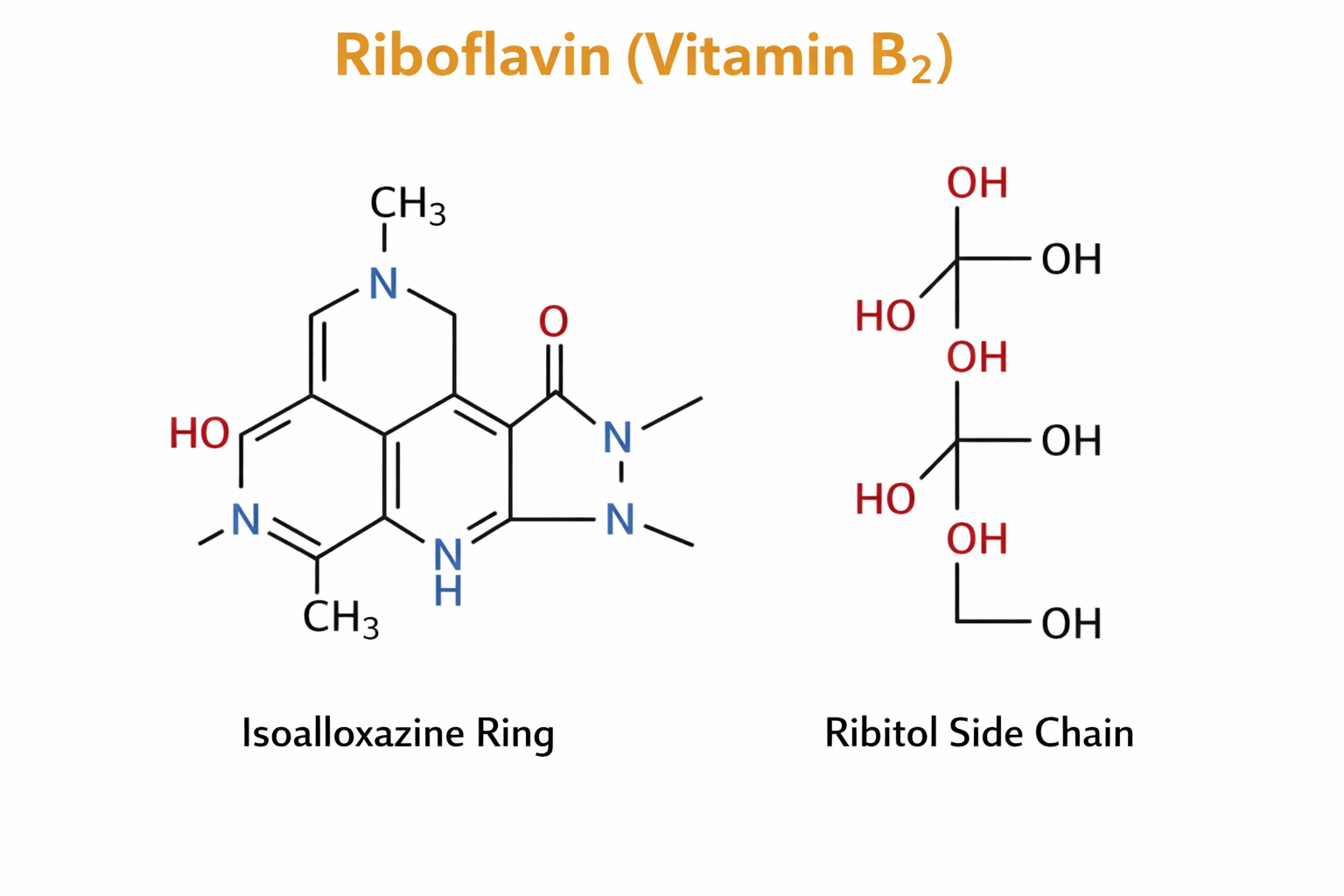
Riboflavin is a yellow, crystalline, water-soluble compound composed of a heterocyclic isoalloxazine ring attached to a sugar alcohol side chain known as ribitol. The name “riboflavin” is derived from “ribose” (reflecting the ribitol moiety) and “flavin” (from flavus, meaning yellow).
Riboflavin: Isoalloxazine ring − Ribitol side chain
The isoalloxazine ring system is the functional core of the molecule and is responsible for its redox properties. This ring can undergo reversible reduction and oxidation, allowing riboflavin to participate effectively in electron transfer reactions.
Structurally, riboflavin consists of:
- A tricyclic isoalloxazine ring, which accepts and donates electrons
- A ribitol side chain, which enhances solubility and facilitates enzymatic binding
The coenzyme derivatives of riboflavin are formed by modification of this structure:
- Flavin mononucleotide (FMN): formed by phosphorylation of riboflavin
- Flavin adenine dinucleotide (FAD): formed by addition of an adenosine monophosphate (AMP) moiety to FMN
These structural modifications enable tight binding to specific enzymes as prosthetic groups.
Physical Properties
- Riboflavin is a yellow–orange crystalline substance that gives a yellow color to solutions and urine.
- It is slightly soluble in water, and solubility increases with heat.
- It is insoluble in nonpolar solvents like chloroform and ether.
- It shows yellow-green fluorescence under ultraviolet (UV) light.
Chemical Properties
- Riboflavin is heat-stable, so it is not easily destroyed during cooking.
- It is very sensitive to light, especially UV light, and can be destroyed when exposed (e.g., milk in clear bottles).
- It is stable in acidic conditions but unstable in alkaline conditions.
- It acts as a redox compound, meaning it can accept and donate electrons in metabolic reactions.
 Occurrence of Vitamin B₂
Vitamin B₂, commonly known as riboflavin, occurs in biological systems either as free riboflavin or as a component of complex proteins known as flavoproteins, which function predominantly as enzymes. It is widely distributed in nature and is present in virtually all living cells of both plant and animal origin.
Rich dietary sources of riboflavin include liver, wheat germ, yeast, milk, meat, fish, and eggs. Leafy green vegetables, fruits, and most root vegetables also contribute appreciable amounts. Although grains and cereals are relatively poor sources, their riboflavin content increases during germination. Dietary deficiency is frequently associated with low consumption of milk and animal-derived proteins.
Riboflavin is relatively stable to heat; however, it is highly sensitive to ultraviolet and visible light. Consequently, significant losses may occur when foods—particularly milk—are stored in transparent containers and exposed to light. Pasteurization of milk can also result in a measurable reduction in riboflavin content.
In contemporary nutrition, food fortification has become an important additional source of riboflavin. Fortified cereals, enriched flour, and certain beverages contribute significantly to intake in many populations. Although limited synthesis of riboflavin by intestinal microbiota has been described, it is not considered a reliable source for human nutritional needs. Being a water-soluble vitamin, riboflavin is susceptible to loss during cooking, especially with boiling and prolonged exposure to water.
Biochemical Role of Vitamin B₂
Riboflavin serves as a precursor for two essential coenzymes:
FMN (Flavin Mononucleotide)
FAD (Flavin Adenine Dinucleotide)
These coenzymes are integral components of a wide variety of oxidation–reduction (redox) reactions in cellular metabolism.
FMN functions as a coenzyme for several enzymes, including cytochrome c reductase, L-amino acid dehydrogenase, and Warburg’s yellow enzyme. FAD serves as a coenzyme for enzymes such as xanthine oxidase, liver aldehyde oxidase, and acyl-CoA dehydrogenase.
Enzymes that contain riboflavin-derived coenzymes are collectively termed flavoproteins. These enzymes play a central role in catalyzing redox reactions essential for cellular energy production.
In modern biochemical understanding, FMN and FAD act as tightly bound prosthetic groups in numerous mitochondrial dehydrogenases. They are critically involved in the electron transport chain, particularly within Complex I (FMN-dependent) and Complex II (FAD-dependent), thereby contributing directly to adenosine triphosphate (ATP) generation.
Beyond energy metabolism, riboflavin-dependent enzymes participate in multiple metabolic pathways, including:
- Fatty acid β-oxidation
- Amino acid metabolism, including oxidative deamination
- Conversion of tryptophan to niacin
Additionally, riboflavin plays an indirect but vital role in antioxidant defense. The FAD-dependent enzyme glutathione reductase maintains intracellular levels of reduced glutathione (GSH), which protects cells against oxidative stress and membrane damage.
Deficiency of Vitamin B₂ (Ariboflavinosis)
Riboflavin deficiency does not produce a single, distinct disease entity but instead manifests as a constellation of clinical features collectively referred to as ariboflavinosis. Tissues with high cellular turnover—particularly ectodermal tissues such as the skin, eyes, and mucous membranes—are most susceptible. Experimental Findings
In experimental animal models, particularly rats, riboflavin deficiency results in growth retardation, degeneration of nervous tissue, and ocular abnormalities such as corneal vascularization and cataract formation. Additional findings include dermatitis and alopecia. During pregnancy, deficiency may lead to congenital malformations in the developing embryo. Clinical Features in Humans
In humans, riboflavin deficiency presents with characteristic mucocutaneous and ocular manifestations:
- Oral and Cutaneous Lesions:
- Inflammation and cracking of lips (cheilosis)
- Fissures at the angles of the mouth (angular cheilitis)
- Seborrheic dermatitis-like lesions, especially around the nose, ears, and nasolabial folds
- Greasy scaling of the skin
- Tongue Changes:
- Magenta-colored tongue (magenta glossitis)
- Atrophy and flattening of lingual papillae
- Ocular Manifestations:
- Conjunctival and corneal inflammation
- Corneal vascularization
- Photophobia (light sensitivity)
- Burning, itching, and dryness of the eyes
- Reduced visual acuity
These ocular symptoms are attributed to impaired flavoprotein-dependent oxidative metabolism in rapidly dividing epithelial tissues of the eye.
Risk Factors and Predisposing Conditions
Certain populations are at increased risk for riboflavin deficiency, including:
- Individuals with chronic alcoholism
- Patients with malabsorption syndromes (e.g., Celiac disease)
- Individuals with prolonged inadequate dietary intake
- Pregnant and lactating women with poor nutritional status
- Populations consuming predominantly refined, non-fortified cereal-based diets
Additionally, some medications, including phenothiazines and tricyclic antidepressants, may interfere with riboflavin metabolism and utilization.
Summary
Riboflavin is an essential water-soluble vitamin with widespread distribution in natural foods and critical involvement in cellular redox reactions. Through its coenzymes FMN and FAD, it plays a central role in energy production, intermediary metabolism, and antioxidant defense. Deficiency leads to a characteristic syndrome affecting the skin, mucous membranes, and eyes, particularly in vulnerable populations with inadequate dietary intake or increased physiological demand.


Copyright © 2023. STUDYANDEXAM. All Rights Reserved.